



Logistics
Date & Time: Wednesday March 4, 2026 | 2:00 PM – 3:15 PM CET / 4:00 PM – 5:15PM EAT
Background
Elections are moments of heightened democratic vulnerability across Africa. They concentrate political competition, expose civic space to legal and security restrictions, and intensify digital repression through surveillance, internet shutdowns, and coordinated disinformation campaigns. For youth-led movements and civic actors, elections are not only opportunities for participation, but also periods of increased risk.
Across the continent, young people are often the first to experience and respond to these pressures. They lead voter education, election observation, community monitoring, and digital accountability efforts, while simultaneously navigating shrinking civic space, restrictive laws, and online harassment. In many contexts, electoral periods function as testing grounds for new forms of repression and manipulation that later become normalized beyond election cycles.
This webinar approaches elections not as a technical exercise, but as a critical lens to examine democratic resilience. It explores how African youth act as a first line of democratic defense during electoral moments, resisting civic space closure, countering digital repression, and demanding accountability. By grounding the discussion in lived experience and recent electoral cycles, the webinar will generate insights that feed directly into the 2026 GDC Africa Regional Forum.
Objectives
- Examine elections as moments of heightened vulnerability for civic space, democratic accountability, and digital rights across Africa.
- Explore how digital repression, including disinformation, surveillance, and internet shutdowns, is deployed during electoral periods and how youth-led actors respond.
- Highlight African youth not as beneficiaries or target groups, but as frontline democratic actors leading resistance, monitoring, and accountability efforts.
- Identify strategies and protective practices that enable youth to engage safely and effectively in electoral moments marked by repression and risk.
- Capture lessons and insights to inform the Africa Regional Report and shape discussions at the 2026 GDC Africa Regional Forum on youth agency, digital resilience, and democratic renewal.
Speakers / Experts Profiles
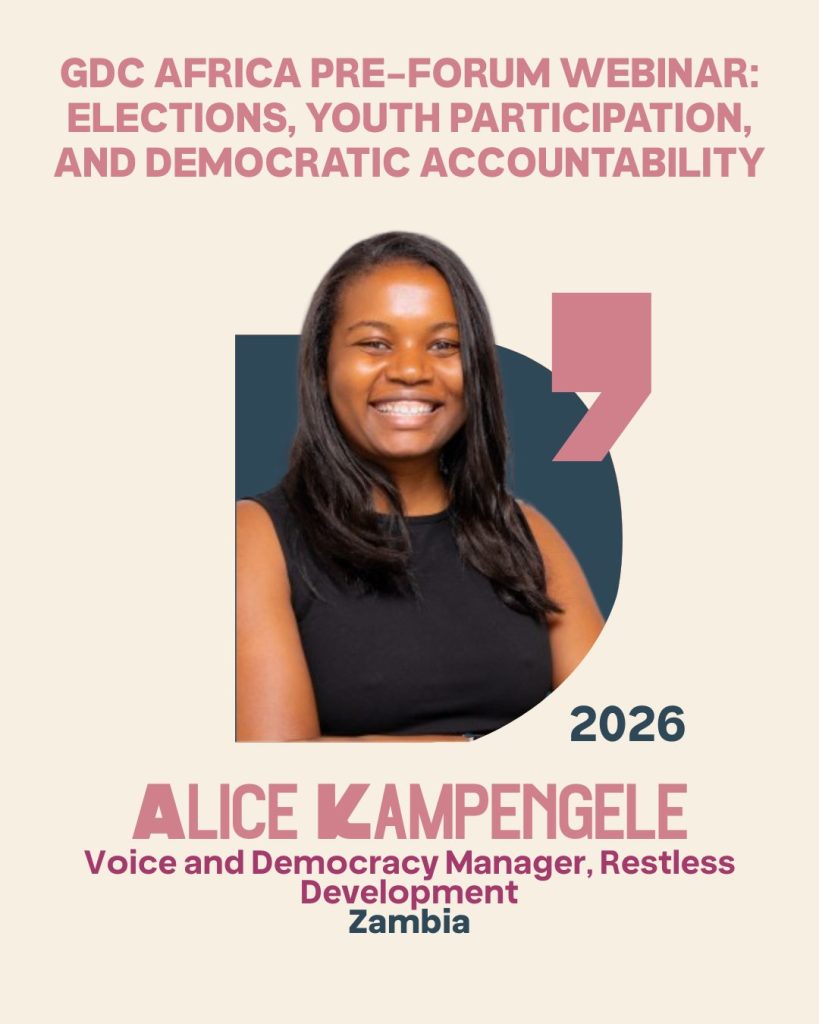
Alice Kampengele
Voice and Democracy Manager, Restless Development
Alice Kabunda Kampengele is a Zambian youth engagement and gender equality advocate who serves as Voice and Democracy Manager at Restless Development, the global youth‑led development agency. Her work centers on strengthening youth civic participation, supporting youth‑led civil society, and advancing feminist leadership, areas reflected across her public professional profile.
She has built experience in programme strategy, systems design, and cross‑organizational coordination, contributing to initiatives that expand young people’s influence in democratic processes. Her approach emphasizes creating structures that help youth‑led groups access resources, build capacity, and participate meaningfully in decision‑making spaces.
Kampengele’s commitment to feminist principles is visible in her involvement in efforts addressing gender‑based violence and promoting safer, more equitable communities for young women and girls. She is also connected to international youth governance spaces, including participation in the AU‑EU Youth Voices Lab, a platform focused on strengthening youth perspectives in Africa‑EU cooperation.
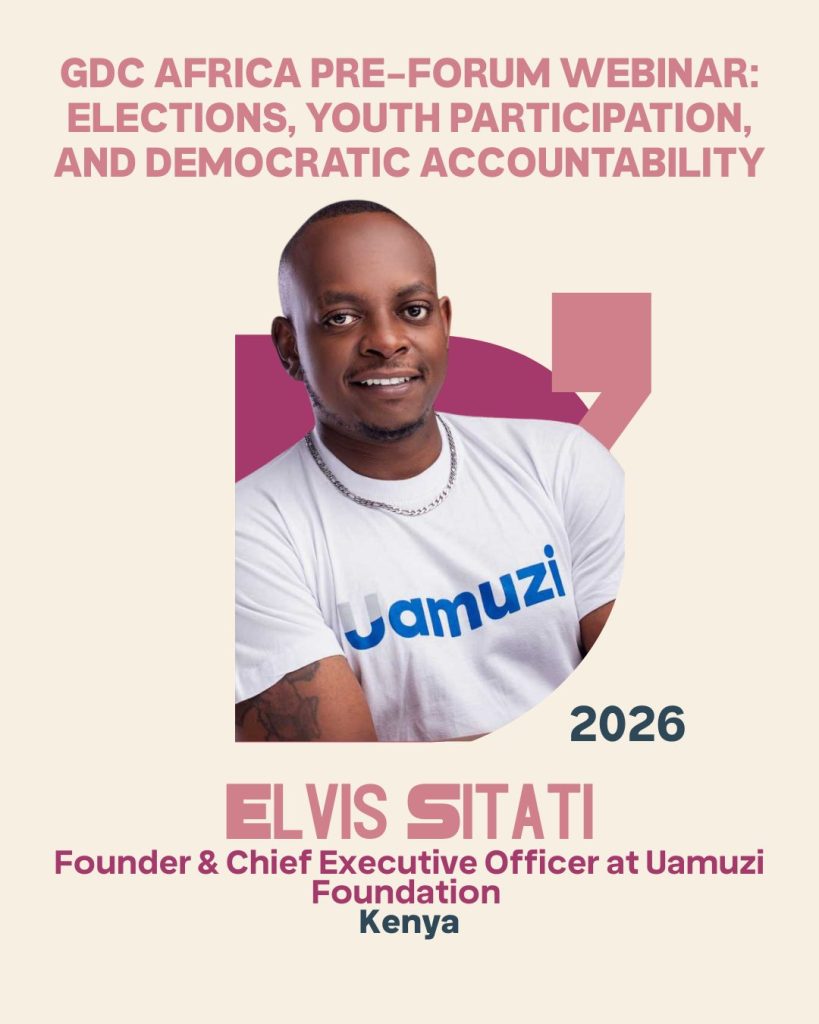
Elvis Sitati
Founder & Chief Executive Officer at Uamuzi Foundation
As the Founder and Chief Executive Officer at Uamuzi Foundation, Elvis spearheads a dedicated team committed to amplifying the voices of marginalized groups, specifically the youth, women, and persons living with disabilities by leveraging technology and real-time data to ensure their representation at the decision-making tables.
With a solid foundation in business leadership, he has earned a reputation as an exceptional and passionate leader within the corporate sector. His expertise lies in orchestrating effective team dynamics, crafting strategic frameworks, and driving successful executions across various sectors.
Throughout his career, he has cultivated a track record marked by adeptness in leadership, strategic thinking, and business development. He is recognized for his mentorship initiatives and for being a proactive achiever, consistently delivering results that make a meaningful impact.
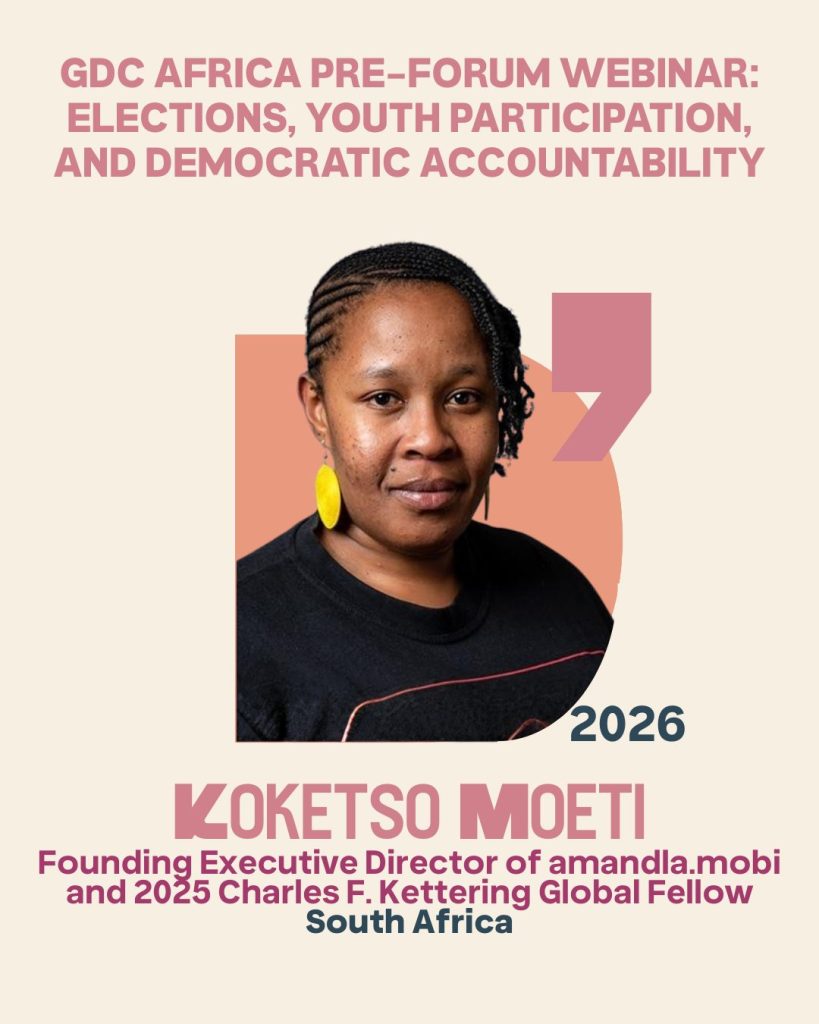
Koketso Moeti
Founding Executive Director of amandla.mobi and 2025 Charles F. Kettering Global Fellow
Koketso Moeti has a long background in civic activism and has over the years worked at the intersection of governance, communication and people-power. She currently serves as the Founding Executive Director of amandla.mobi. Prior to this, Moeti worked and consulted for a wide range of national and international organisations. In 2025 she was announced as a Charles F. Kettering Global Fellow. She is also an inaugural New Voices Advanced Advocacy Fellow (2024); inaugural Keseb democracy Fellow (2023); Mulago Foundation Rainer Arnhold Fellow (2022); inaugural Collective Action in Tech Fellow (2021), Atlantic Fellow for Racial Equity (2019); inaugural Obama Foundation Fellow (2018) and an Aspen Institute New Voices Fellow (2017). Koketso also serves as a member of WITNESS’ Board of Directors; an expert Advisor to the World Economic Forum’s ‘Partnering with Civil Society in the Fourth Industrial Revolution‘ initiative and a founding reference group member for the Civic Tech Innovation Network. She is an alumnus of the Inclusive Global Leadership Initiative (IGLI) summer institute, hosted by the Sié Chéou-Kang Center at the University of Denver. When not working, Moeti can be found writing and has been published by The Guardian, City Press, Project Syndicate, the Mail & Guardian, NPR and Al Jazeera, among others.
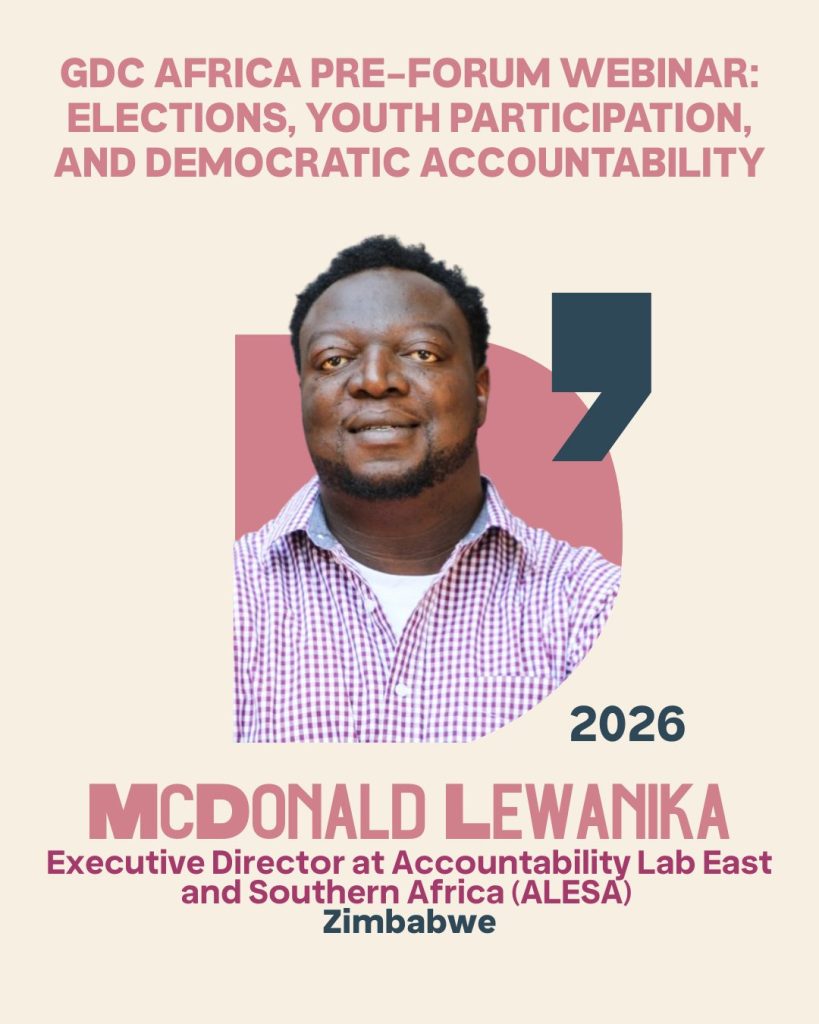
MODERATOR: McDonald Lewanika
Executive Director at Accountability Lab East and Southern Africa (ALESA)
McDonald Lewanika is a Zimbabwean governance expert and civil society leader who serves as Executive Director for Accountability Lab South and East Africa, a role publicly listed by the organization. He oversees regional strategy, partnerships, and programmes that strengthen accountability, support civic actors, and promote open governance across multiple countries.
His background includes senior leadership roles in Zimbabwe’s civil society sector, where he worked on democracy, advocacy, and citizen participation. He is known for contributions to political analysis and commentary in Southern Africa, with published work and media engagement examining governance, elections, and civic space.