

Logistics
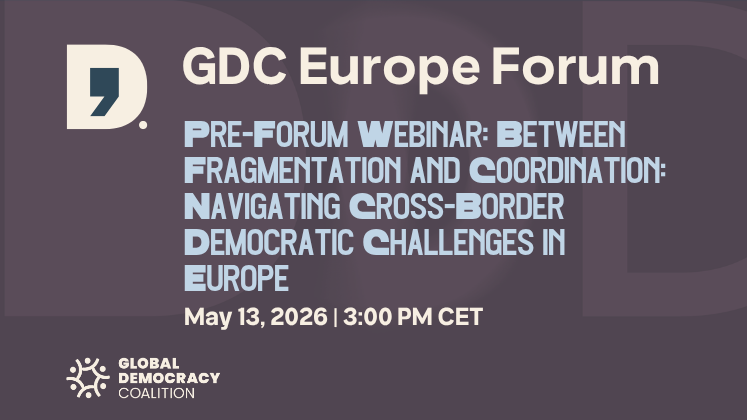
Date & Time: Wednesday, May 13, 2026 | 3:00 PM CET / 9:00 AM ET
Online Platform: Zoom (will be livestreamed on GDC YouTube channel)
Co-hosting Organizations: European Democracy Youth Detwork (EDYN), Global Democracy Coalition
Livestream Details: Coming Soon!
Background
Democratic challenges in Europe are increasingly transnational in nature. Disinformation, electoral interference, and digital manipulation operate across borders, often exploiting differences in national systems, regulatory approaches, and political contexts.
At the same time, responses to these challenges remain largely fragmented. While regional institutions, national governments, civil society actors, and private sector stakeholders are all engaged in efforts to strengthen democratic resilience, coordination across these levels is often limited, uneven, or reactive. This creates a central tension: the threats to democracy are increasingly interconnected, but the responses remain dispersed.
This webinar explores this tension without presuming a single solution. It brings together perspectives from across sectors to reflect on where coordination is working, where it is not, and what barriers continue to limit more effective collective responses.
By focusing on this structural challenge, the discussion will help inform the Europe Regional Forum, particularly conversations on cross-border interference, electoral integrity, and collaborative approaches to democratic resilience.
Objectives
- Examine the transnational nature of contemporary democratic challenges in Europe
- Explore the gap between cross-border threats and nationally anchored responses
- Identify structural barriers to coordination across sectors and levels of governance
- Reflect on existing efforts and their limitations
- Generate insights to inform forum discussions on collective responses and democratic resilience
Speakers / Experts Profiles
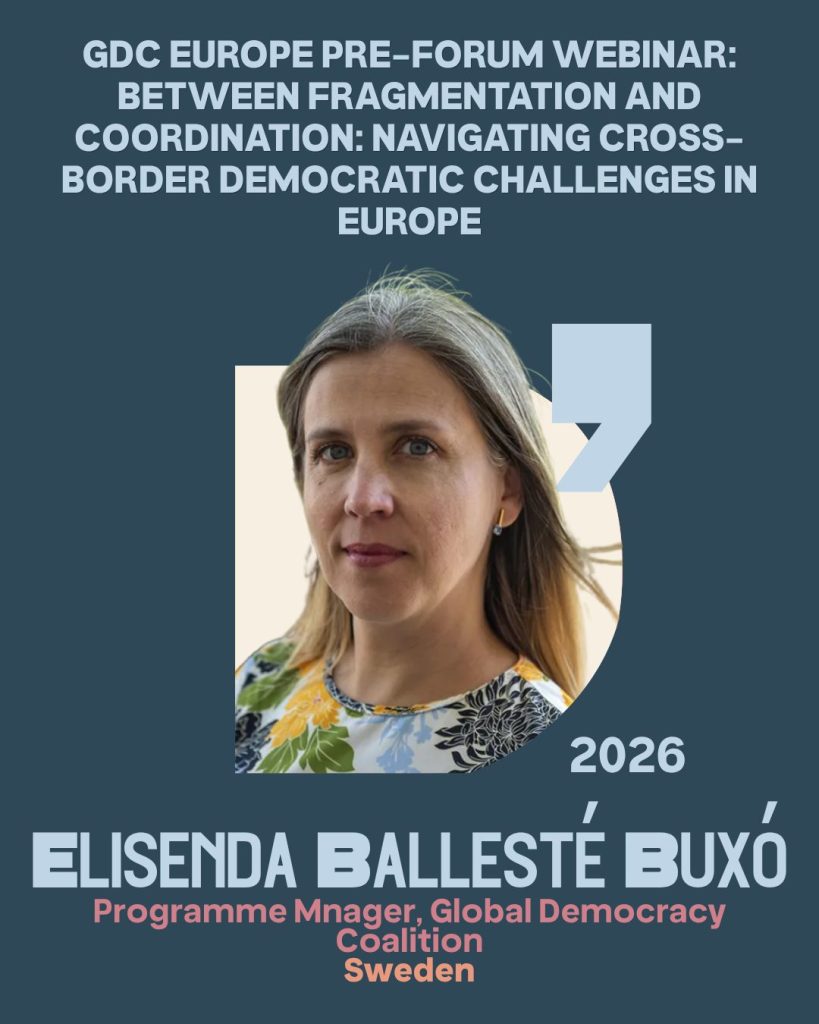
MODERATOR: Elisenda Ballesté Buxó
Programme Manager, Global Democracy Coalition
Elisenda Ballesté Buxó is the Program Manager of the Global Democracy Coalition, a strategic multi-stakeholder alliance of organizations to advance and protect democracy. The Coalition helps to amplify the voices of individual organizations, allows for dialogue across regions, themes and sectors, and enables individual organizations to have greater impact as part of a collective effort to advance and protect democracy. International IDEA is one of the co-coordinators of this initiative. Prior to this, Elisenda managed the EU co-funded Global Monitor of COVID-19´s impact on Democracy and Human Rights project, an online monitoring tool of Covid-19 measures adopted by the 165 countries covered in the Global State of Democracy Indices. She was also responsible for the Middle East subregion in the Global State of Democracy Report and In Focus, producing analysis and assessment on democratic trends and issues. Before joining International IDEA, Elisenda was an academic in various universities in Mexico. She has cooperated closely with NGOs and presented lectures at several international conferences.
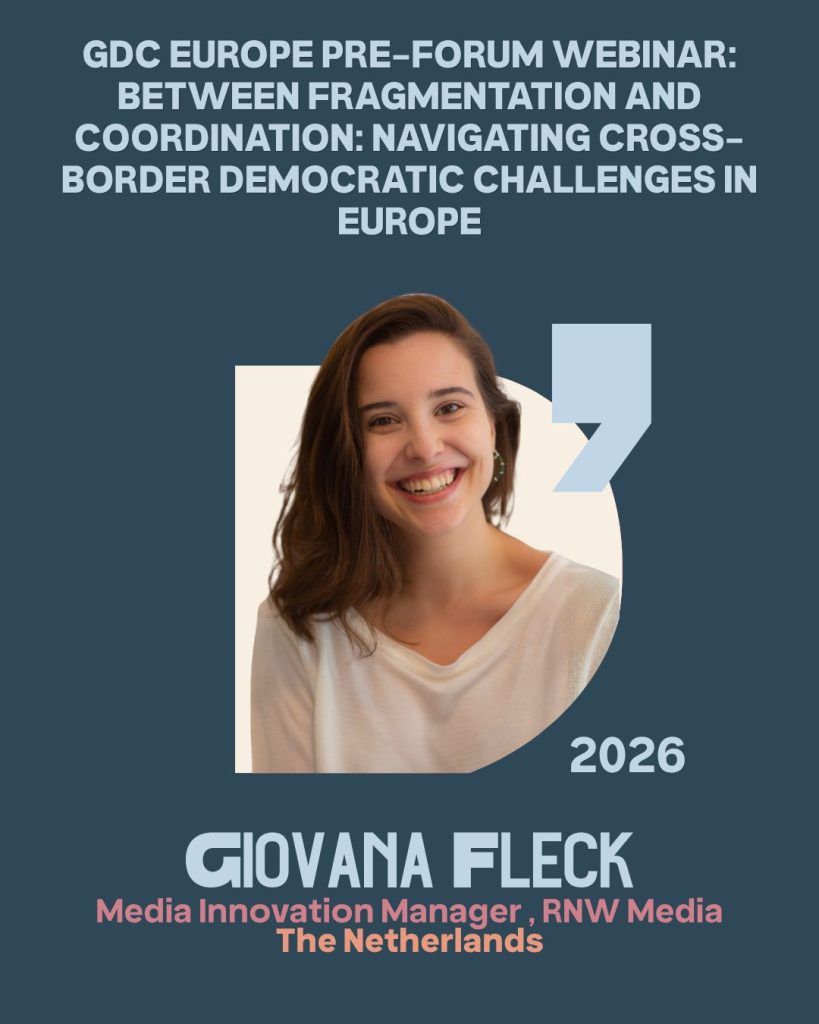
Giovana Fleck
Media Innovation Manager, RNW Media
Giovana Fleck is a journalist working on the intersection of technology and human rights. Her work spans critical areas, including reporting and researching digital policy, narrative analysis, disinformation, and ways to build healthier information ecosystems. She holds a master’s degree in journalism and political communication from the University of Amsterdam and the University of Aarhus, with a specialization in Data Journalism at Columbia University.
She led Global Voices’ Civic Media Observatory and worked as an editor for stories about the Lusophone Africa region. Currently, she leads the information integrity portfolio at RNW Media.
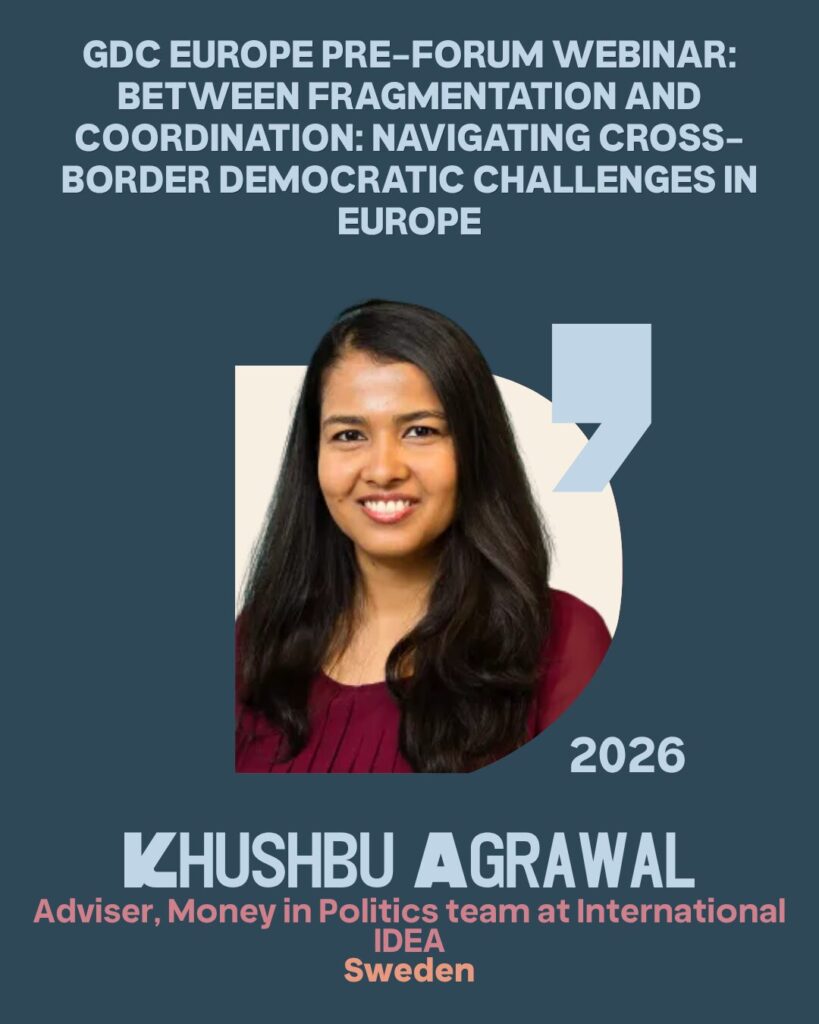
Khushbu Agrawal
Adviser, Money in Politics, International IDEA
Khushbu Agrawal is the Adviser, Money in Politics in the Global Programmes Unit.
Agrawal’s research and work focus on political finance and influence of money in politics, and achieving inclusive, responsive and accountable institutions and processes. She has previously worked at the Institute’s Regional Office for Latin America and the Caribbean in Santiago, Chile, wherein she was responsible for the implementation of all programme activities at the regional level, with a special focus on electoral integrity, political finance, equitable political participation and democracy strengthening.
Her previous work experience includes conducting research, policy analysis, and programme development and evaluation, particularly in the areas of gender, peace and conflict, and equitable political participation, in organizations such as the International Organization for Migration, Save the Children and International IDEA’s Nepal Office.
She holds a master’s degree in Public Policy from the Australian National University. In 2016, she was awarded the Canadian Government´s federal scholarship to participate in the Global Change Leaders´ Program at the Coady International Institute in recognition for her leadership role in her community.
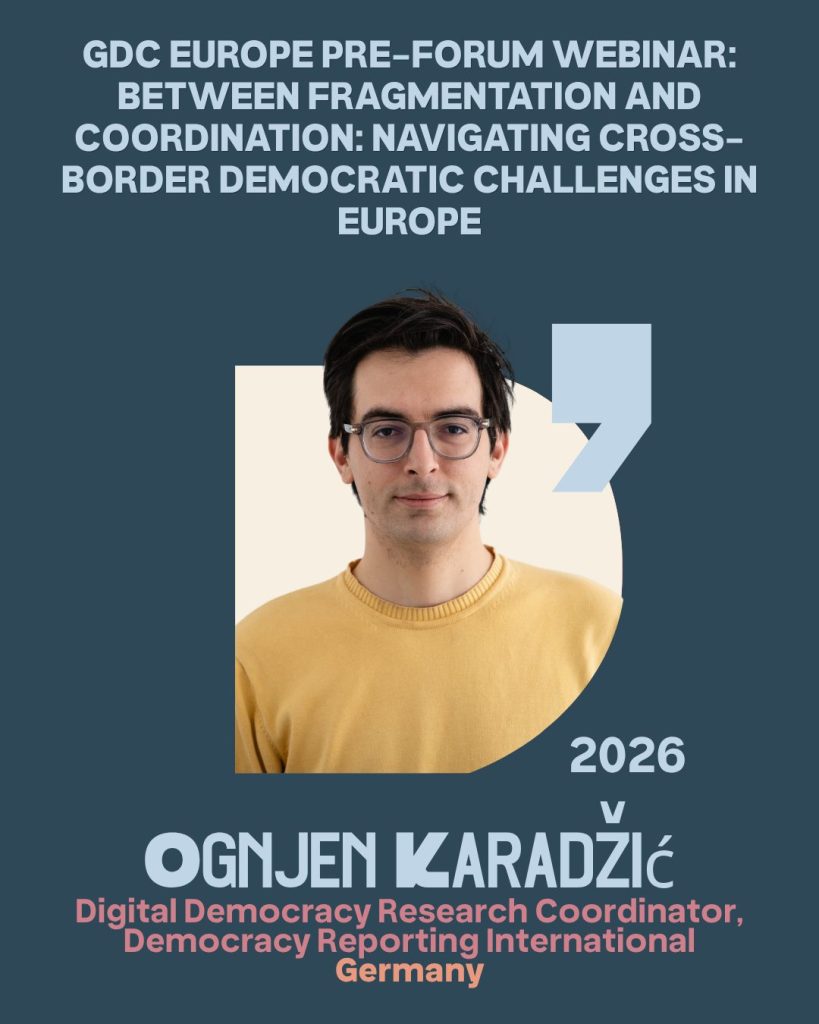
Ognjen Karadžić
Research Coordinator – Digital Democracy, Democracy Reporting International
Ognjen Karadžić is a Digital Democracy Research Coordinator at Democracy Reporting International, where he investigates political discourse and coordinated inauthentic behavior (CIB) in electoral contexts across Europe. Everything and anything research-related will sooner or later find its way onto Ognjen’s task list. As Research Coordinator, Ognjen leads a group of researchers investigating online disinformation, hate speech, polarisation, and other phenomena shaping online communication around elections, with a focus on translating data into policy-relevant outputs.
Ognjen holds an MA in Sociology from Freie Universität Berlin and is a PhD candidate at the Faculty of Philosophy, University of Belgrade. Beyond his core work, Ognjen’s personal research interests range across three distinct areas: the ethical implications of generative AI in education and democracy, political stability, and moral pluralism.
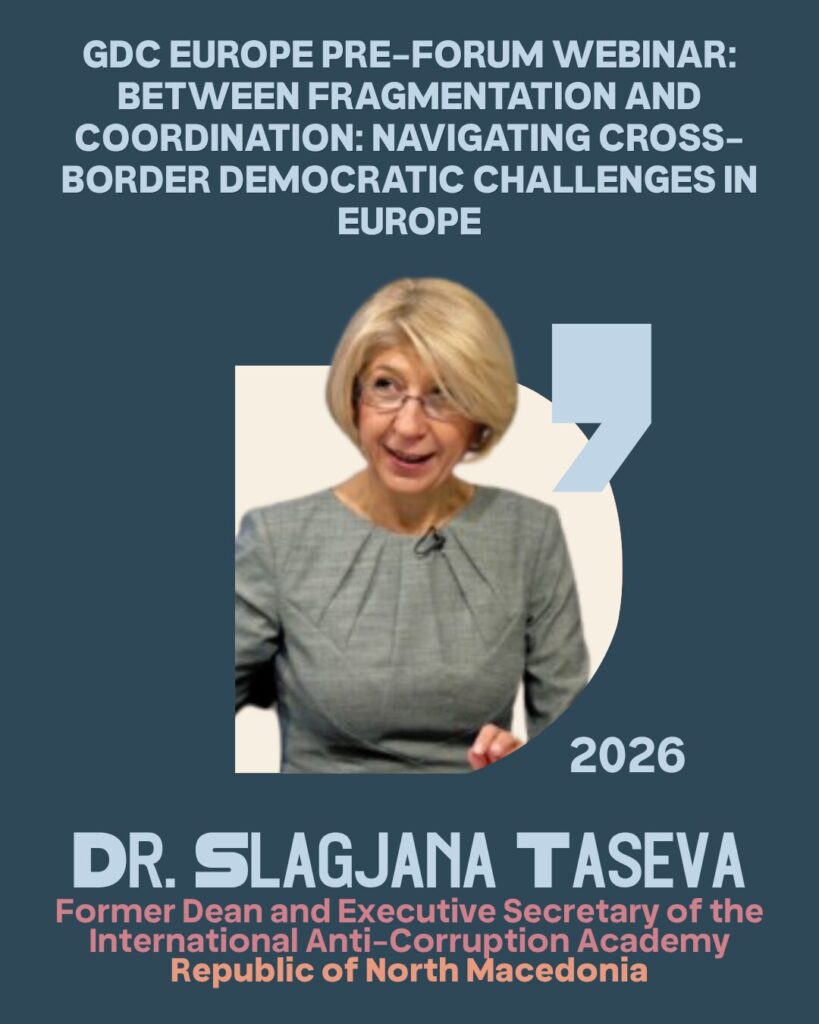
Dr. Slagjana Taseva
Former Dean and Executive Secretary of the International Anti-Corruption Academy (IACA)
Dr. Slagjana Taseva is the former Dean of the International Anti-Corruption Academy (IACA), a professor in criminal law and criminology, former Committee member of the Afghanistan International Anti-Corruption Monitoring and Evaluation Committee(MEC) and Chair of TI Macedonia. Together with her children she has established EURISK Consulting, the Legal Consulting Company.
Being specialised in money laundering, financial crime, corruption and organised crime she holds a PhD in law from Sts. Cyril and Methodius University in Skopje where she started her remarkable academic career. In 2006 she became Vice President of the Association of the European Police Colleges. In 2008 she was appointed Dean of the Faculty for Detectives and Criminalists at the European University of the Republic of Macedonia. Since 2010 she is General Manager of EURISK Consulting.
Besides her remarkable professional career, she founded the NGO Transparency International Macedonia in 2001 and in 2006 she became the Chair. From 2002 to 2007 she was President and member of the State Commission for Prevention of Corruption. Furthermore, she was heading the GRECO delegation for the Republic of North Macedonia (2007-2012) and has been elected in the GRECO Bureau. In 2000 – 2005 Professor Taseva has participated in numerous evaluations in Moneyval (Committee of Experts on the Evaluation of Anti-Money Laundering Measures and the Financing of Terrorism) in Latvia and Poland as well as evaluator and reporter for GRECO in several countries including Bosnia and Herzegovina, Belorussia, Lithuania and Russia. Alongside her anti-corruption activities Professor Taseva has also been very active in the field of money laundering. Amongst several studies and research papers she has published the book “Money laundering” in 2003 which second edition has been published in English language in 2007.
For the anti-corruption activities Professor Taseva has received several rewards amongst them “Person of the Year 2003” from Forum Magazine and “Person of the Year 2004” from New Women Magazine.