
Written by Elisenda Ballesté Buxó
Democratic cooperation is easy to invoke and considerably harder to build.
Across the Asia-Pacific, democracy advocates are confronting shrinking civic space, financial uncertainty, digital surveillance and increasingly sophisticated forms of authoritarian control. At the same time, geopolitical shifts are forcing democratic actors in the region to reconsider who their allies are, where support will come from, and what regional cooperation should look like in practice.
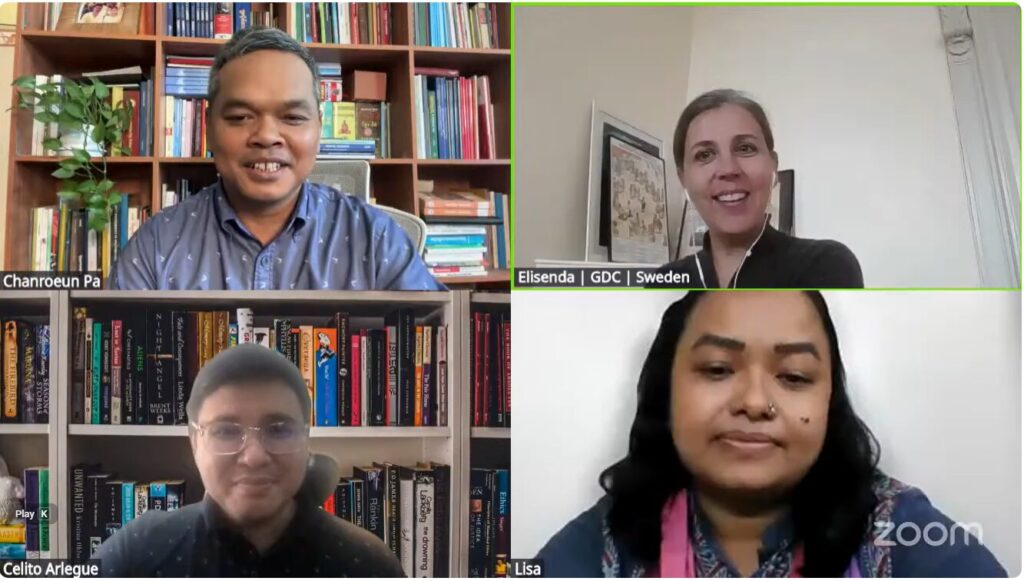
In June 2026, the Global Democracy Coalition convened its Asia Forum in Seoul, bringing together democracy practitioners, civil society representatives and researchers from across the region to discuss the state of democratic cooperation in Asia. Following the Forum, the GDC spoke with three of its participants: Chanroeun Pa from the Cambodian Institute for Democracy (CID), Aklima Ferdows Lisa from Policy Analysis and Research Initiative (PARI), and Celito Arlegue from the Council of Asian Liberals and Democrats (CALD).
The conversation did not set out to summarize the Forum. It asked a harder question: what would democratic cooperation in Asia actually require: in practice, not in principle?
The Seoul discussions had gone deeper than the other regional forums held earlier this year. Where previous conversations had centered on shared concerns about democratic backsliding, funding, and youth participation, the Asia Forum pushed further into institutional adaptation, the governance of technology, and the structural conditions that make regional cooperation either possible or hollow. As Arlegue observed, the challenge is particularly acute in a region where, as he put it, democracy is far from being the norm, where many countries remain authoritarian or only partially democratic.
One question, posed by Arlegue early in the conversation, set the frame for everything that followed: what do we actually mean when we speak about democratic cooperation?
Cooperation Cannot Remain a Slogan
For Arlegue, the problem is not that democratic actors disagree on the need to cooperate. The problem is that they rarely discuss how, under what leadership, with what incentives and on the basis of what shared responsibilities.
“Cooperation does not happen automatically,” he said. He argued that democratic actors need to be honest about the practical conditions that make cooperation work: why actors would cooperate, what each stands to gain, what they are realistically able to contribute, and who should lead. Without that clarity, he suggested, even the most genuine expressions of solidarity remain declarations rather than structures.
He also pointed to something often left unsaid: trust. Not only between countries, but between sectors. Civil society and political parties, he noted, often remain deeply suspicious of each other, and that suspicion is not unfounded. “We also have to recognize that some democratic actors are still not trusting each other,” he said.
“There are still confidence-building measures that need to be undertaken to make political parties or members of parliament work with civil society.”
Lisa brought the same concern to ground level. She argued for a shift from top-down, state-dominated governance toward more inclusive and decentralized civic participation, and emphasized that cooperation has to produce visible, concrete outcomes. Her concern was less with the architecture of cooperation than with its results: “We need more actionable commitments, rather than verbal ones, particularly around cross-border networks.” She pointed to cross-border alliances and transnational learning networks as among the most practical and underutilized tools available to democratic actors in the region, particularly for organizations working under restrictive conditions that make domestic action increasingly difficult.
Chanroeun Pa added a dimension that grounded the conversation in lived experience. He described the situation in Cambodia as one in which civil society, political actors and ordinary citizens each occupy separate, mistrustful worlds. What is needed, he said, is not agreement but space : “spaces where people can sit down and listen to each other, open their hearts to hear.” That, he suggested, is where democratic cooperation actually begins.
Asia Looking Within: The Role of Middle Powers
One of the most substantive and politically specific threads in Seoul concerned the countries expected to lead democratic cooperation in the region: South Korea, Japan, Taiwan, and Australia and New Zealand as partners adjacent to the region, and the gap between that expectation and political reality.
The Forum was held in conjunction with the Korean Democracy Foundation, and for Chanroeun Pa the visit to its museum became one of the most resonant experiences of the week. What struck him was not only the institution itself but what it represented: a society that had absorbed its own democratic history and made it publicly accessible, presenting the story of how democracy evolved as civic education rather than official narrative. “Having seen this museum, I started thinking that we should build a Cambodian Democracy Museum in the future,” he said. “Even if we don’t have the resources now, at least I have that dream.”
The museum also illuminated a gap that the Forum discussed directly: the relationship between democratic memory and new generations. As one participant observed during the Forum, Gen Z does not necessarily have a political ideology, which makes the existence of spaces like the Korean Democracy Museum all the more significant. “It is necessary to have stories to tell and evidence to show,” Chanroeun Pa reflected.
On the political question of middle powers, Arlegue offered an important corrective to the usual framing. It is tempting, he said, to simply call on South Korea, Japan and others to “step up” and lead democracy promotion in the region. But that framing ignores real constraints. From his conversations with colleagues in those countries, he heard a consistent message: these governments do not see themselves as natural leaders of regional democracy promotion, at least not unilaterally. Domestic democratic challenges, unresolved historical tensions between countries in the region, and deeply ingrained caution about projecting influence all shape what is and is not politically feasible.
“The interest and the willingness is not yet there,” he said. “We still need to push them to make them realize that given the current geopolitical moment, it is their responsibility. Because otherwise, who is going to take that role?”
That realism led to a more concrete and actionable proposal, raised during the Forum by civil society leaders with direct experience lobbying in Japan: rather than asking middle powers to spend more on democracy promotion, the ask should be about reallocation. Much of the official development assistance currently provided by countries like Japan and South Korea flows directly to governments in the region, including, in some cases, authoritarian ones. Redirecting even a portion of that ODA toward civil society would represent a significant shift without requiring new budget commitments.
Chanroeun Pa described parallel advocacy work in Japan, where direct engagement with parliamentarians from across the political spectrum had begun to create openings. The argument proved more effective, he noted, when delivered not as a demand but as evidence: when democratic governments channel support exclusively through authoritarian states, they end up strengthening those states, not the citizens living under them.
Civil Society in Survival Mode
Perhaps the most sobering thread of the conversation concerned the condition of civil society organizations across the region. Chanroeun Pa described it plainly: many organizations are no longer focused on how to advance their mission. They are focused on how to stay alive.
“We are in the survival stage,” he said. He described a compounding set of pressures in Cambodia: political suppression, the loss of international funding following the withdrawal of USAID, and the growing threat posed by the unethical use of digital technology against civic actors. The question, he said, is no longer only how to build democracy. It is how to ensure that the organizations doing that work continue to exist.
Lisa described the same dynamic from Bangladesh: restrictive laws, digital surveillance, escalating threats against human rights defenders, and a shrinking civic space that limits what organizations can publicly do. She argued that under these conditions, the most important form of cooperation may be transnational, not because it bypasses the national level, but because it provides protection, visibility and solidarity that purely domestic actors cannot generate alone. “Cross-border learning and resilient alliances can protect fundamental freedoms at this moment,” she said.
That observation resonated with what the Forum itself had surfaced: organizations sharing legal strategies, funding diversification approaches and communications practices not as an academic exercise but as a means of institutional survival. Lisa’s point landed with particular force in that context: Asia’s democratic actors may be operating in very different political environments, spanning sub-regions as distinct from one another as Central Asia and Southeast Asia. But they face structurally similar pressures, and the experience of one can directly strengthen another.
Lisa also pointed to a gap that often goes unaddressed not in what gets discussed, but in who is genuinely present to shape those discussions: grassroots organizations, Indigenous communities and youth-led movements are frequently named as priorities while rarely holding a real seat at the table. Cooperation organized primarily among established civil society institutions may inadvertently reproduce the same exclusions it sets out to contest. Genuine decentralization of civic participation, she argued, requires deliberate investment in these actors, not just acknowledgment of their existence.
Governing Technology Democratically
The Asia Forum brought the most developed conversation on artificial intelligence of any of the four regional forums held this year, specifically the risk that decision-making authority shifts from accountable human institutions to opaque algorithmic systems, with no clear mechanism for citizens to understand or contest those decisions. Chanroeun Pa framed the issue carefully: AI is not inherently threatening to democracy, but it is not inherently beneficial either. Its effects depend entirely on how it is governed and by whom.
He described an effort in Cambodia in which around twenty civil society organizations collectively advocated to be included in a formal government consultation process on digital policy, and ultimately secured a seat at that table. That experience shaped his view that civil society’s role in AI governance is not peripheral but essential. He noted that the executives of major AI companies now sit alongside heads of state at forums like the G7, accumulating a form of political influence that civil society has not yet found ways to match or counterbalance.
The governance question is also an institutional one. Lisa pointed to the need for democratic institutions themselves to become more adaptive to digital manipulation and the forms of political influence that AI enables. Without that adaptation, she suggested, legal and institutional frameworks designed for an earlier era will continue to lag behind the realities that civic actors are already navigating on the ground.
The Forum also gave participants a term for something they had been experiencing without always having language to describe it: algocracy, governance by algorithm. It captures a phenomenon that is reshaping political life across the region without always being visible as a form of governance at all.
The Democratic Long Haul
For Chanroeun Pa, the significance of the Seoul gathering was also deeply personal. Hearing that democracy advocates elsewhere were confronting similar pressures, that the experience of isolation and difficulty was shared, not singular, gave him something he had not expected to find in a regional forum.
“I feel warm and not lonely anymore,” he said.
That sense of connection, he suggested, is not incidental to democratic cooperation. It is part of what makes it possible. Civil society organizations are not, he noted, the only defenders of democracy; they are facilitators. The real work belongs to people. What organizations like his can do is invest in those people, especially the young, and create the conditions for them to act.
Arlegue closed the conversation with a note of honesty that doubled as a call to action. The problems that democratic actors in Asia are confronting will not resolve themselves with geopolitical shifts elsewhere in the world. Whatever changes in Washington or Brussels, the structural conditions of authoritarianism, digital control and civic fragmentation in the region will require sustained, long-term work.
“Democracy is something we have to defend for the long haul,” he said. “We have to prepare for that. And in the process, we also need to take care of each other, because the work we are doing is not easy, but it is absolutely necessary.”
This article is based on conversations held with Aklima Ferdows Lisa, Director of Policy Analysis and Research Initiative (PARI); Celito Arlegue, Executive Director of the Council of Asian Liberals and Democrats (CALD); and Chanroeun Pa, President of the Cambodian Institute for Democracy (CID), following their participation in the GDC Asia Regional Forum held in Seoul in June 2026. The interview was conducted by Elisenda Ballesté Buxó, Programme Manager of the Global Democracy Coalition, as part of the GDC’s 2026 Asia Regional Month.