
By Nicki Kalfas, Programme Associate, Global Democracy Coalition
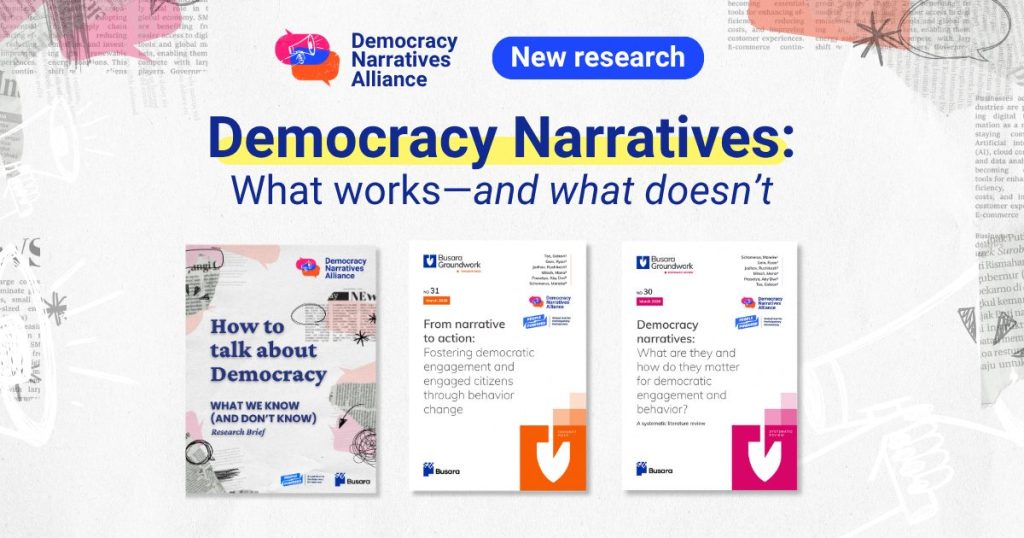
The March 24, 2026 webinar, Democracy Narratives: What Works – and What Doesn’t, marked the public launch of the Democracy Narratives Alliance (DNA), a global initiative dedicated to strengthening democracy through evidence‑based narrative strategies. The event brought together researchers and practitioners from People Powered, Busara, Fundación Corona, and the Global Democracy Coalition to unveil a new set of resources synthesizing nearly 400 publications, 150 empirical studies, and insights from over 30 international organizations and funders. It was an ambitious and timely conversation, arriving at a moment when democracy’s legitimacy is increasingly shaped by meaning, emotion, and lived experience rather than institutional design alone. A recording of the webinar is available for those who wish to explore the full discussion.
Clara Bois, Partnerships Director at People Powered, opened the session by naming the core tension shaping today’s democratic landscape. Around the world, people continue to express support for democracy in principle, yet many feel that democratic systems do not work for them in practice. Clara’s framing is especially relevant now, as democratic backsliding accelerates in countries where citizens feel unheard or excluded. Her point that people “don’t think they have a meaningful say in government” resonates across regions where participation has become procedural rather than empowering. In an era defined by distrust, her reminder that disengagement is rooted in experience, not ideology, feels both urgent and clarifying. It also underscores the deeper challenge the webinar repeatedly surfaced: people are not only losing faith in democratic performance, but in democracy’s meaning in their lives.
Elisenda Ballesté Buxó, Program Manager at the Global Democracy Coalition, expanded on this diagnosis with a level of candor that felt timely. She argued that democracy faces not only a performance problem but a meaning problem. This distinction matters. People are not turning away from democracy because they reject its ideals; they are turning away because democracy feels abstract, distant, and disconnected from their daily struggles. Elisenda’s observation that authoritarian narratives succeed because they are simple, emotional, and repeatable is particularly relevant in a media environment dominated by short‑form content and algorithmic amplification. Her insistence that this is not merely a communications challenge but a narrative one reflects a broader shift happening across the democracy field: a recognition that facts alone cannot compete with stories that speak to identity, frustration, and belonging. This meaning gap, between what democracy promises and what people feel, emerged as the thread linking every contribution in the webinar.
The research presented by Gideon Too, Vice President at Busara, provided empirical grounding for this argument and underscored why narrative work is so critical right now. His team’s systematic review revealed that democracy is experienced not only through values and institutions but through a set of everyday practices: upholding democratic principles, participating in democratic processes, expressing dissent, and cultivating personal investment through trust and belonging. This framing is highly pertinent in contexts where democratic institutions exist on paper but fail in practice. Gideon’s emphasis on the “vicious cycle” of negative experiences leading to disengagement, which then weakens democracy further, captures a dynamic visible across multiple regions today. His reminder that narrative change must address systemic, communicative, and personal dimensions simultaneously is a timely challenge to democracy practitioners who often focus on only one of these layers. His findings reinforce the core argument: without narratives that restore meaning, even well‑designed democratic reforms struggle to take hold.
Ryan Gem, Learning and Evaluation Manager at People Powered, introduced the research brief How to Talk About Democracy, which distills the Alliance’s findings into practical guidance for communicators, organizers, and policymakers. His explanation that narratives function as mental models, frameworks people use to make sense of the world, feels particularly relevant in a moment when misinformation and polarization are reshaping public understanding. Ryan’s argument that effective democratic narratives must activate shared values rather than rely solely on information speaks directly to the current communications environment, where attention is scarce and emotional resonance often determines whether a message is heard at all. His emphasis on values such as dignity, fairness, and belonging reflects a growing recognition that democracy must be communicated not as an abstract system but as a lived promise. This shift from information to meaning is not cosmetic; it is foundational to rebuilding democratic legitimacy.
The webinar also featured a compelling case study from Colombia, presented by Diana Dajer, Democracy Manager at Fundación Corona. Her team’s research on youth voting behavior found that future‑oriented messages, those that link participation to shaping one’s own future, were the strongest motivators for young people. This insight is especially relevant now, in a global moment when young people are increasingly disillusioned with political systems that feel unresponsive, extractive, or outdated. Diana’s findings challenge the narrative that young people are apathetic; instead, they reveal a generation searching for agency and for democratic processes that acknowledge their aspirations. What her research makes clear is that young people are not disengaging because they do not care about democracy, they are disengaging because democracy has not shown that it cares about them. Her work demonstrates that narrative strategies can measurably shift behavior when they speak to identity, possibility, and personal impact.
Taken together, the webinar offered a clear message: democracy’s future depends on our ability to tell better stories. Stories that reflect lived experience, center shared values, and offer a vision of what democracy can build, not only what it must defend. The Democracy Narratives Alliance represents a rare and necessary model of coordinated, evidence‑based narrative strategy in a field that has long worked in silos. Its work invites practitioners to move beyond intuition and toward intentional, research‑driven storytelling that can rebuild trust, relevance, and engagement. Above all, it calls for a shift from defending democracy’s structures to renewing democracy’s meaning.
What this webinar made unmistakably clear is that the future of democracy work hinges on whether we can close democracy’s meaning gap, whether we can build narratives that reconnect democratic ideals to people’s lived realities. This is the “so what”: without a shift toward meaning‑rich, value‑anchored storytelling, even the strongest reforms will struggle to take root. The Democracy Narratives Alliance offers a roadmap for this shift, but its impact depends on practitioners, advocates, and institutions choosing to act on it. Explore the research brief and other resources to take the next step in strengthening democracy’s story, and its future.
Published 6 May, 2026.
About the Author:
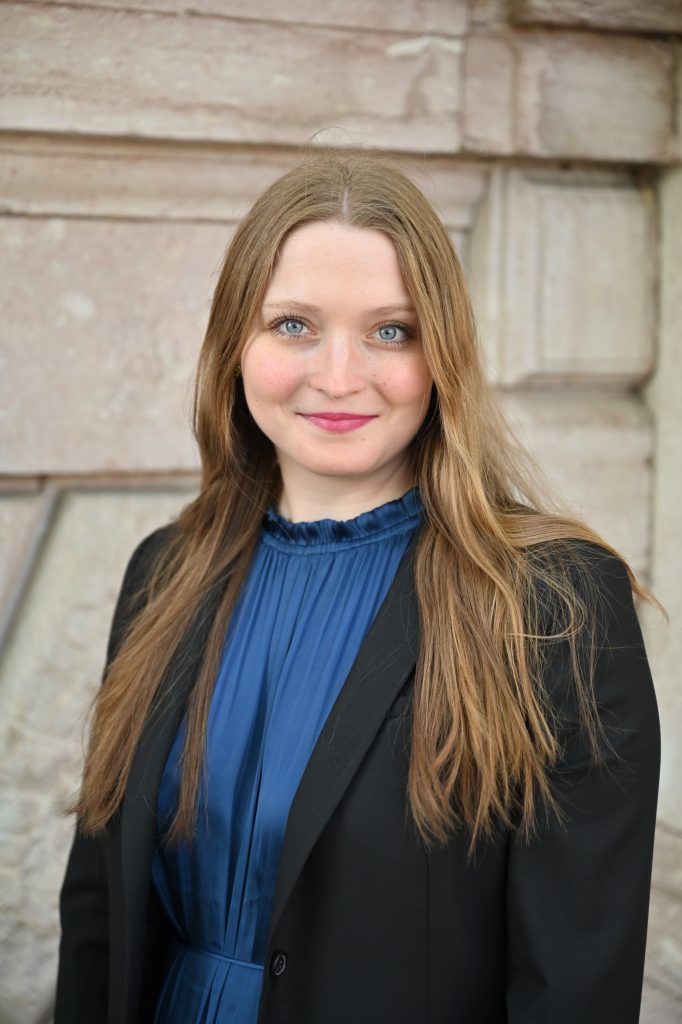
Nicolette Karina Kalfas
Programme Associate, Global Democracy Coalition
Nicolette Karina Kalfas serves as the Programme Associate for the Global Democracy Coalition, a dynamic multi-stakeholder alliance dedicated to advancing and safeguarding democracy worldwide. Nicolette’s tenure with International IDEA began in April 2024, where she plays a pivotal role in orchestrating the coalition’s engagement in the GDC Forums, advocacy campaign, and all communications products.